Friday, 19 April 2013

2013 Hurricane Season Outlook

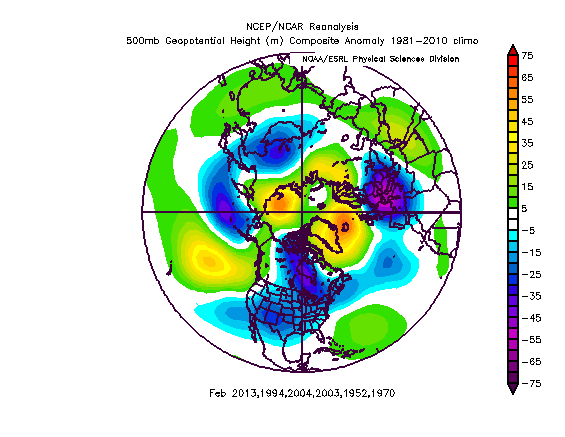
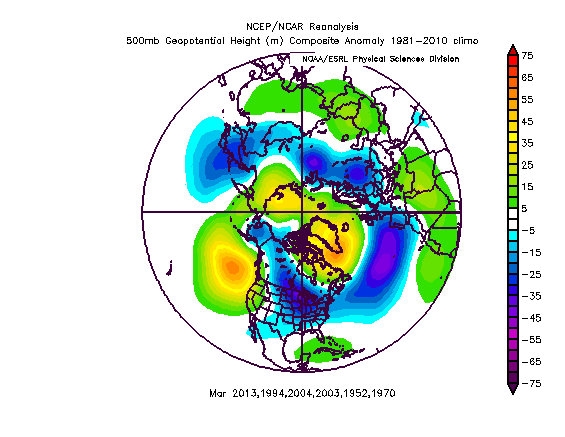
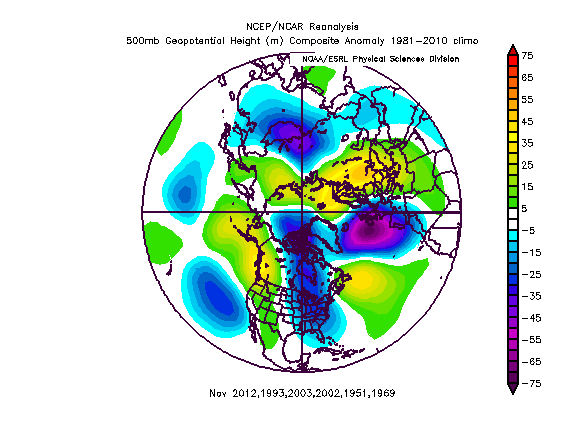
Welcome to my 2013 hurricane outlook. This year will be a challenge for forecasters as we have a neutral ENSO state, moderation in the -PDO and warm AMO pattern.  Lets get right into my analog package.
Top 3 Analogs 

The top year I have been looking into is 2003 which had a weak el nino summer and a warm AMO. The 500mb pattern in the summer featured a trough in the east and a ridge in the west which is what I am expecting this summer. The european is consistent with this type of pattern setting up. Notice the cluster of tracks east of florida and in the western gulf.
1996 is my second best match which had a weakening moderate la nina, similar to this year. It also had eastern troughiness in the JJA 500mb pattern. We also see the spray of tracks originating off of Africa and spreading towards the eastern caribbean and carolinas. This was another active year along the eastern seaboard with a +AMO pattern.
1952 has a nice ENSO match with a similar spread of tracks. Several systems may have went unnoticed in the North Atlantic with the lack of satellite data.
Here is my full analog package SST blend:

If we compare it to this year, notice the similarities with the cool western gulf and warm AMO tripole. There is also cool water in nino 1 and 2.
ENSO

ENSO will be a very key driver for this years hurricane season. The european and canadian guidance suggest a weak modiki el nino throughout the summer with dryness around florida/cuba. The euro monthlies has a trough over the great lakes with a near normal hurricane season in the atlantic basin. It is suggesting two spreads of tracks, one extending from the MDR towards the gulf states and a second one along the eastern seaboard late in the season. Given the overall pattern in place, I agree with the overall tracks advertised by the european but disagree on ENSO state. Currently, we have an area of warmer then normal subsurface SST anomalies between 140E and the dateline. These anomalies may make an attempt to upwell in the central ENSO regions but in a modified form. 

We continue to see OLR anomalies clustering around the maritime continent/eastern IO which supports a neutral ENSO/weak la nina pattern. The atmosphere is not headed towards an el nino very quickly given the lack of a strong subsurface warmth which.

Mid tropospheric easterlies west of the date line and subsequent SOI rises will prevent an incoming el nino. A la nada or very weak el nino is what I am expecting by late summer. This should not prohibit hurricane development given the lag effect involved with a changeable ENSO state. With this being said, we need to look at other factors that can influence the hurricane season.


QBO

Currently we are experiencing a downwelling easterly QBO state which should strengthen into a westerly state by the summer. A downwelling easterly QBO will help promote easterly winds in the stratosphere with lower heights over the caribbean and an increased hurricane threat in the atlantic basin this summer. Notice how the easterlies are already beginning to strengthen in the subtropics around 50mb which is consistent with my analogs (1964 and 1969).
Hurricane Track Forecast

Within a positive AMO period we should always be on the lookout for hurricane tracks up the eastern seaboard. I think this year will be no different with several threats from the carolinas to New England and towards the eastern caribbean. Several of my analog years are pointing towards east coast storm tracks such as Isabel, Juan, Fran and Dora. Many systems may end up tracking just to the east of the northeast coast. In august and september several central caribbean and gulf of mexico tracks are likely as storms shift southwestwards and the bermuda high weakens. Florida will be in the middle of this  track spread which means that it is also at risk of several land falls. I don't feel as if this is a hurricane season like 2005 or 2004 but an above normal season is in the works with a -NAO likely this may with a build up of warm SST's in the MDR. 


Wednesday, 27 March 2013

Summer 2013 Outlook

Key points

  • The core of the heat will be centered across the eastern rockies and central plains states in june before shifting northwards as we head into july and august
  •  Drought conditions will persist across the central part of the CONUS and intensify across the intermountain west and southern prairies
  • Normal precipitation is expected across the great lakes and northeast with an active severe weather season likely across the ohio valley, great lakes and ontario. 
  • Much warmer then normal temperatures will occur in the western great lakes with near to above normal temperatures in the northeast.
  • Drier then normal conditions will continue across the southeast in june before much needed rains become more common in the second half of summer
ENSO
The current IRI forecast predicts a warm biased la nada as we head into the summer. I think that this is likely given the current warmer then normal sub surface temperature anomalies in the pacific. A full blown el nino is unlikely with a -PDO allowing warm water to drift southwards. SOI values have been variable lately with changeable SST's. Important to note is the warmest SST's are focused across eastern ENSO regions which would help intensify the summer heat. This would also allow more Sub Tropical energy to send moisture into the southeast and gulf coast states.
CPC forecast:
Current SST's consist of a warm AMO tripole with east based warmth in the tropical pacific.


Analogs

For my summer analogs I focused on years with a +AMO, -PDO and neutral ENSO state coming after a weak la nina. For my analogs I used 1932,1936, 1937, 1952 and 2012. Here are the temperature departures from the blend of years.

Precipitation

The temperature trend on these years is very similar to my summer thoughts. Notice how the heat is centered across the eastern rockies, plains states and extending northeast towards the great lakes. Cooler weather is likely along the west coast in the -PDO regime but the intermountain west may end up hotter and drier then the analogs show. An active monsoon season is present across the SW causing near to slightly below normal temperatures. I am also expecting wet conditions across the southeast in mid to late summer which is showing up in the analog package and european monthlies.


I will break down each analog year individually.

1932
This year had a moderate la nina in the winter season before a transition to la nada by the early summer. The warmest water temperature anomalies were centered in nino 1+2 which helped cause a hot summer across the central and eastern u.s. Dry conditions expanded northeast towards the great lakes region.
June to August SST's
Palmer Drought Index

Temperature Departure
1936
1936 was a weak la nina with a warm AMO and cold PDO horseshoe. This was a very hot summer across the western great lakes and plains states. I don't think this year will end up as hot as 1936 due to the neutral ENSO state predicted as opposed to a la nina which would enhance ridging in the mid latitudes.
Temperature Departures

Palmer Drought Index
1952

1952 had a downwelling easterly QBO with a neutral ENSO state coming after an el nino winter. The heat was centered further Southeast then I am expecting.
2012

I added last summer to my analog set because the ENSO trend was very similar along with the PDO and AMO states. I do expect a wetter and cooler summer across the northeast and eastern great lakes compared to last year. Notice the cooler anomalies across the southeast.
1937

This year came after three la nina years in a row which is very similar to our current ENSO state. Widespread warmth occurred similar to much of the 1930's and 1950's.

Tropical Forcing

This summer I am expecting negative OLR anomalies to develop across the indian ocean and maritime continent. This should work together with cooler SST's near the dateline with warmth off the coast of south america. The CFSv2 is pointing towards a northwards momentum transport between the equator and the tropic of cancer which favours more southern branch moisture and ridging in the central u.s. Phases 2-5 of the MJO/GWO will be common this summer in my opinion.


My Temperature Forecast


Precipitation Forecast:


Monday, 25 March 2013

Long Range Outlook

So far this march we have seen a tongue of colder then normal anomalies develop underneath a powerful block in the arctic. Here are the temperature departures for the month so far.
 Reduced: 90% of original size [ 565 x 437 ] - Click to view full image
Attached Image

I tried to match up some years so that we can get a better idea of what april will look like. Here is what march looked like in my analog years which is pretty close to what we have seen so far. Notice the warmer then normal anomalies across the bering sea with the tongue of cold extending from NW to SE.
 Reduced: 90% of original size [ 565 x 437 ] - Click to view full image
Attached Image

I will break down each year in my analog set.
1965

1965 had a very cold march with strong blocking west of greenland. The core of the cold was focused towards the northern plains, prairies and western great lakes. We also saw a transition to neutral ENSO conditions in the spring. In april of 1965 we saw cold shots focused across quebec, ontario and the great lakes with warmth building up across the southern tier of the CONUS.
 Reduced 40%
Attached Image
1064 x 429 (84.7K)

2002

In 2002 we saw very similar temperature anomalies in march with a slow transition out of cold bias la nada conditions. In april cold shots were common across the north as the PV drops south at times.
 Reduced 41%
Attached Image
1069 x 430 (84.36K)


2011

In spring 2011 a moderate to strong la nina began to weaken into a la nada state. It had a warm AMO and -PDO as well which matched nicely.
 Reduced 42%
Attached Image
1088 x 428 (86.22K)


2009

2009 is one of the top analogs in my set with a cold start and a warm finish. The ENSO signal was also very similar with a +AMO and -PDO. The first half of april is on the left and second half on the right.

 Reduced 41%
Attached Image
1073 x 429 (99.86K)


1996
In 1996 we had a very cold march with a similar tongue of cold showing up. Notice the strong blocking over greenland. ENSO trend also coming out of a weak/moderate la nina.
 Reduced 40%
Attached Image
1066 x 428 (83.39K)


Based on analogs, modelling and indices it looks like the first half of april will start off cool across the prairies, great lakes and quebec as pieces of the PV drop south. A weak -NAO and ridge along the west coast will allow cold shots to move down with warmer temperatures across the southern u.s. Towards the end of the month the weak -NAO/AO couplet should begin to relax and the -PNA trough begin to re-establish itself along the west coast. This will allow the heat from the south to begin to move northwards towards the ohio valley, great lakes and northeast. I still think that moisture stays above normal in and around the GL's with northern branch features dropping down, especially in the first half of the month. I do see a drier trend in the great lakes towards the end of the month with the SE ridge strengthening and less blocking across greenland. With features moving into the ridge expect some severe weather to break out, mostly south of the canadian border but a shift northwards is likely in may. Once we get out of this cold pattern, it looks like a quick snap to above normal conditions is likely. 

Sunday, 24 February 2013

Eastern Canada, Brace Yourself Again!

Winter Storm Forecast Discussion:
Meteorological Synopsis

A 996mb storm is currently located across SE new mexico and is expected to move northeastwards towards the lower great lakes region. Snows are already breaking out across the eastern rockies as the storm taps into cold air from the north. A swath of snow will develop along the rim of the cold air which will effect southern and eastern ontario starting early wednesday morning and continuing into thursday for southern quebec. The storm is expected to occlude as it does so which will cause a prolonged period of wintry precipitation (12-24 hours). Heavy wet snow will begin to develop across southern ontario by 3am wednesday as boundary level temperatures stay well below zero. Moderate to heavy snow will work into the ottawa/montreal regions by the afternoon hours. This type of snow will be quite moisture laden sticking to any exposed surfaces including trees and power lines. Power outages will become a concern from kitchener through the GTA and up towards kingston as winds gust up to 60kph at times. By wednesday evening precipitation will begin to taper off across southern ontario but light to moderate snowfall may add an additional accumulations wednesday evening/night.

Forecast Risks and Uncertainties:

TROWAL- A trough off warm air aloft will form south of lake erie allowing for intense lifting to occur along the west end of lake ontario. The location of this deformation band will determine who picks up 30cm+ from this event. The 0z european run showed this band pivoting over the GTA but the current run has shifted this 25-50 miles further NE. If the next run of the euro returns to its original ideas accumulations will have to be taken up along the west end of lake ontario.

Dry Slot- Some models are pointing towards a dry slot potential across the area. Dry air intrusion will occur because of the strength of the storm. The strength and location of the secondary low will determine the strength and duration of this. If the secondary tracks further west we will see longer duration precipitation moving into S, E On and quebec. I think most areas from kitchener to kingston see a primary thump of 14-20cm from the main band with additional wrap around precipitation afterwords. Ottawa, montreal and SW ontario will see slightly weaker returns on the primary band.

Temperatures- I think boundary layer temperatures are supportive of predominantly snow from london to montreal and ottawa. I think southern niagara, windsor and areas directly along lake ontario will see some mixing but most of the province should stay as all snow. The heavy precipitation caused by the storm will help cool the column especially in the heavier bands. Ratios should stay between 8-10:1, being highest at night or when the sun angle is lower.

With all these factors in front of us here are my forecasted amounts across the effected area:
Toronto downtown: 15-25cm, winds gusting to 60kph
Toronto (St Clair to Steeles): 17-27cm
York Region: 20-30cm
Hamilton: 14-24cm
Guelph/Grimsby: 15-25cm
Kingston: 20-30cm
London: 11-21cm
Bruce/Walkerton/Mount Forest: 5-15cm
Barrie: 15-25cm
Windsor: 10-20cm
Montreal North: 15-25cm
Montreal South Shore: 10-20cm
Newmarket: 20-30cm
Ottawa: 10-20cm
St Catherines: 13-23cm

If you have any questions, comments or would like a forecast for your area just ask away! I will update snowfall amounts if needed tuesday evening.

Ethan

Tuesday, 19 February 2013

Southern Ontario Lake Effect Snow

Some key points I wanted to make on the upcoming lake effect snow outbreak across southern ontario

1. Wind alignment starts of as WNW before transitioning to NW and NNW later tonight and into tomorrow morning. Up to 40cm of snow may fall in areas along the shores of GB and lake huron with 850's crashing below -15c and favourable wind alignment aloft. Boundary level moisture will be present from 600 to 800mb with little to no wind shear throughout the region. All these parameters coupled with ice free lake huron and GB will allow for significant LES to set up across southern ontario.


2. I think the GB squall will be strongest and most extensive from midnight tonight through 8am tomorrow morning. This squall should extend into york region and the GTA in the early morning hours wednesday and thursday with accumulations up to 10cm in some spots. This band will weaken but continue to stay active across the barrie, meaford and wasaga areas into mid day wednesday. It should intensify again in the evening hours with significant impacts from meaford to collingwood stretching east to wasaga. I expect a re-intensification wednesday night into thursday morning with further impacts possible across york region again.

3. I am expecting the lake huron band to be stronger with several waves of snow squall activity from tonight into tomorrow afternoon with weakening by 1pm. This zone will set up from owen sound south to london including goderich, kincardine, walkerton, hanover, huron east and lucan. We are already seeing a first band of snow setting up across this region. Northern parts of this zone will get into the second heavy band from midnight to 4am. It should shift into the goderich and kincardine areas by 7am and lasting into the early afternoon. I think the most impacts on london will be from now until 11pm with a WNW flow dominating but they should avoid the second band for the most part. I think weaker but consistent bands of snow will continue to set up through wednesday afternoon and evening from blue water to kincardine. Another intense band should set up through the city of london wednesday night into thursday morning which will be their best chance at heavy snowfall from this event as the flow switches to NW. I am expecting the heaviest accumulations to stay NW of the city but 13-23cm in the city itself.

Here is my snowfall map for this event. In the GB and lake huron squalls i can see some 35cm accumulations locally but most accumulations should stay below 30cm in the dark purple zones.
 Reduced 20%
Attached Image
801 x 577 (304.31K)

Sunday, 17 February 2013

Wet Snow Event for Ontario, Quebec

Here is my forecast map for this event:
 Reduced 38%
Attached Image
1024 x 768 (287.58K)


Key Points
1. Precipitation will stay predominantly as rain from windsor to london. On the front side some mixing with wet snow is likely before the change over. On the back side of the system snow showers will wrap around through the area under the upper level low. 850mb temperatures will hover just below the freezing mark but 925mb temperatures are above zero for most of the event.

2. A line from cambridge/kitchener east to oshawa will see wet snow with this system, mixing with rain at times especially in the morning hours on tuesday. The time of day will be in our favor with 850mb temperatures below zero for the entire event. 925mb temperatures will hover just around the freezing mark with the exception of areas right along the lake shore who will experience mainly rain with this event. I can see 3-8cm accumulations across the area including the GTA north of the lake.

3. From orillia northeast to ottawa and montreal this should stay predominantly as a snow event. Snow will be wet at times especially in areas close to the mixing boundary outlined on the map. I think ottawa, north bay and sudbury have a shot at 10-15cm but i am going with a general 6-15cm across the area. The montreal area may experience some mixing issues with higher boundary level temperatures but precipitation should stay mostly as a wet snow(4-10cm).

Feel free to ask any questions you may have! 

Friday, 15 February 2013

Stormy Pattern Reverses By Mid March

The next 3-4 weeks will be pretty exciting for winter weather lovers across most of the nation. Blocking will be a key player with the MJO headed into unfavourable phases after the 20th of february. The wave will weaken as it propagates eastwards towards indonesia and the philippines which should keep the impacts much smaller. A less active SE ridge will hold until mid march.
 Reduced: 93% of original size [ 547 x 547 ] - Click to view full image
Attached Image

From Feb 20th-March 10th the mean trough will set up in the rockies with a strong blocking high across east hudson bay. Another key player will be the strong trough east of hawaii which will help enhance STJ disturbances. This will cause the mean storm track to set up across the ohio valley, interior northeast and great lakes with phasing possible if the timing is right. The recent SOI drop has definitely enhances STJ moisture which should make for an interesting few weeks as numerous storm systems move across the CONUS. Many storms will take a more southerly track with weakening as they move north into the eastern canada block.
 Reduced 38%
Attached Image
1024 x 768 (310.96K)


As we head into week two and three of march I do believe the SE ridge will begin to take over. Warmth will dominate the east as the stratosphere has cooled rapidly and the la nina continues to intensify. The IOD also looks to be transitioning into a negative state which will help contribute to mid latitude ridging. The GWO continues to stay in la nina phases with very negative MT anomalies and a northward momentum transport. This is responsible for the very active rossby wave train in the pacific and inevitable SE ridge strengthening that should occur in march. The GWO will head into 3/4 with strengthening IO convection.
 Reduced 18%
Attached Image
773 x 1000 (94.5K)


Currently we are seeing a CCKW propagating eastward in the central atlantic which may help amplify the MJO in a couple of weeks as convection increases in the IO region. The -NAO/ phases 1-2 of the GWO will keep the pattern very stormy over the next few weeks from the plains east. By mid march tropical forcing will cause the wintry pattern to break down especially if the MJO re-amplifies in the IO.
 Reduced 24%
Attached Image
840 x 632 (126.73K)